

I am extremely pleased to announce that I am joining the team at Excellent Schools to best support all Principals and leadership groups with the development and implementation of their learning improvement agendas.
What is the focus of Excellent Schools?
The team at Excellent Schools are driven by the twin beliefs that successful learning lies at the heart of school excellence – and every school can achieve a degree of excellence for their learners, irrespective of their size or context. They can achieve this with time, the best support and advice, and the right leadership approach from everybody!
Importantly, Excellent Schools support principals and their teams to consider four crucial improvement questions. For schools, each question serves as a point of entry for further exploration as to how they can achieve their ultimate goal of embedded learning improvement. Thus they form the basis of inquiry questions that drive a unique improvement dialogic at every school. Of course, we have created a range of tools that can support each team’s response to the question they select as their key point of entry.
1. What aspect(s) of learning do we want to improve?
While this may seem to be a simple question, the complexity of describing key aspects of learning improvement is huge and can be overwhelming. Excellent Schools has carefully considered a range of contemporary approaches to student learning to describe three dimensions of successful learners in the excellent phase, namely:
Confident learners; those that most easily embrace the discomfort of challenging learning and conceptual stretch
Agile learners; those that use “complexity thinking” to look deeply into contexts and apply innovative approaches, and
Reflective learners; those that can describe what quality looks like in their endeavours, gauge their progress and be open to feedback.
We have identified the core aspects of these three dimensions, and have developed tools that support schools to identify their priority. We support schools to engage their communities in “blue sky thinking” about their vision for and long term directions in learning improvement, start strategically and build upon their successes.
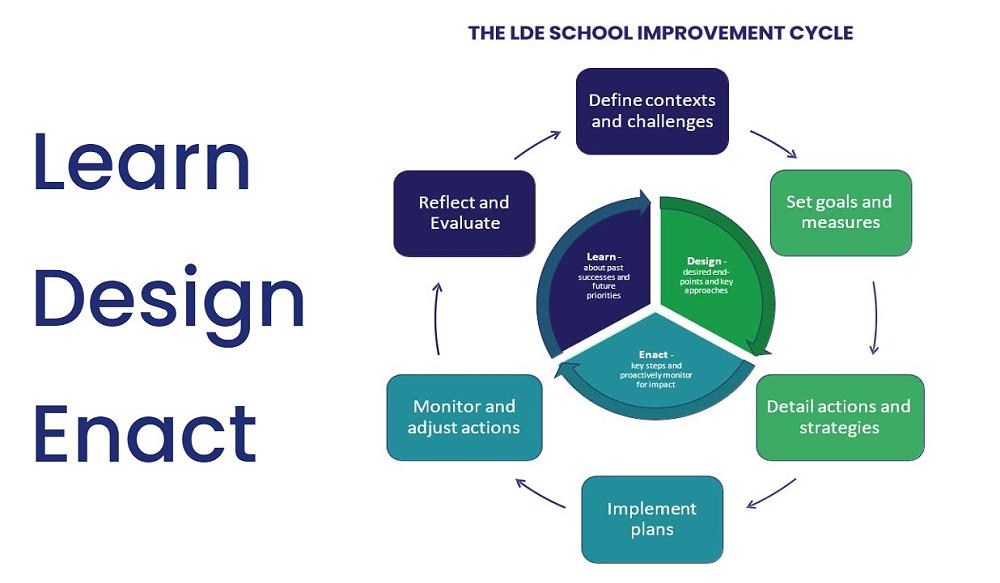
Lastly, in keeping with the Excellent Schools LDE (Learn, Design, Enact) Improvement Cycle, we support schools to establish the tools to track and monitor implementation success in these key areas of learning as well as inform further decisions.
2. By implication, what aspect(s) of teacher practice and the classroom environment do we want to enhance?
As we know, whatever improvements schools are striving to achieve in student learning are directly tied to the types of teacher practice (including pedagogy, curriculum and assessment design) and classroom environment that can best enhance and extend these.
Drawing upon the work of key contemporary thinkers, and aligned with what aspects of learning schools identify as their focus, we support schools to identify what practical and easily implemented changes in teacher practice will get the greatest traction. These changes can be scaffolded to best understand where to proceed after initial success.
Once again, using the LDE (Learn, Design, Enact) Improvement Cycle, we support schools to establish the tools to track and monitor growth in teachers’ confidence and capabilities in key areas of their practice and to inform further directions in professional learning.
3. How do we create the professional environment that will best grow teacher confidence and capability to realise the greatest impact?
The research that Excellent Schools has carried out reinforces that the positive and sustained growth in teachers’ confidence and capability in key aspects of practice can only come about through the deliberate creation of a flourishing professional environment.
Our research has identified those seven areas (what we call “key levers”) that, when implemented across the whole-school, will most effectively support teacher professional growth and student learning improvement. These include: governance processes and the creation of “anchor documents” for clear directions; strategic learning improvement plans and processes; the building of a strong leadership and professional culture; data driven decision making; curriculum and assessment design; the building of student agency and engagement; collaborative professional growth and performance development processes.
Through our Excellent Schools Quality Framework, we support leadership teams to choose and concentrate on those levers that will give the greatest impact in the short to medium term. This work is further enhanced through our bespoke school (self) review processes to most reliably set directions for change against these levers, based on a clear understanding of the present and how to achieve the desirable future.
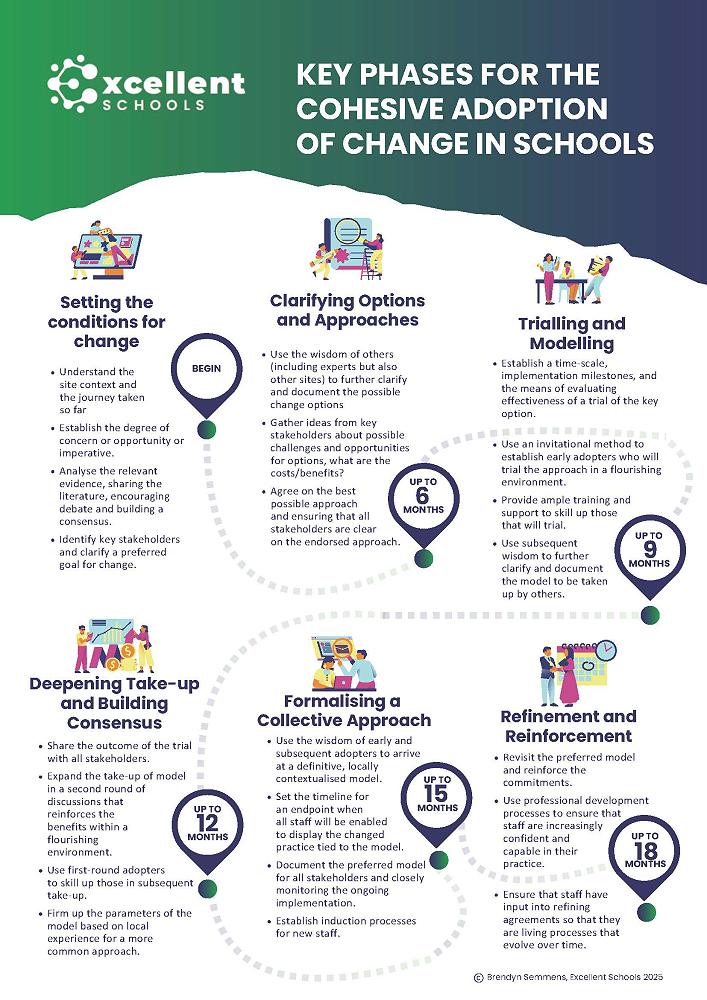
4. How do we ensure our whole school processes and change management strategies will embed improvements in learning over time?
Lastly, we all know the debilitating effect of strategic improvement processes that are ill defined, not owned and understood by key stakeholders, poorly implemented or changed in mid-stream. Such flaws in any strategic improvement initiative can lead to frustration, confusion and fatigue for all concerned!
That is why we have developed our Excellent Schools LDE (Learn, Design, Enact) Improvement Cycle, to ensure that any strategic improvement and change management processes are implemented to the point of being embedded. The LDE Cycle ensures that principals with their teams can lead significant improvement in the whole school environment that will best enhance professional growth and ultimately improve student learning.
To assist in each of the Learn, Design and Enact phases of improvement, we have developed a wide range of tools that can be modified according to each school’s circumstances. We work closely alongside leadership teams to ensure that complexities are overcome and opportunities are amplified. We provide the advice and coaching necessary to ensure the cohesive implementation of the cycle for greatest effect.
We passionately believe that when schools best answer these four questions then students most directly benedict in a climate of excellence.
Our processes, tools and advice are designed to support schools to answer these questions most effectively. Of course, some schools may have an answer to some questions but not all four – we can then help principals to establish an entry point for improvement that best fits their needs. We pride ourselves on our rigour but also flexibility to best meet schools’ needs.
For more information, look at our website and contact us for a discussion!





Recent Comments